
Learning Hub Guide
Signs of Structural Movement
Learn the warning signs of structural movement, when cracks matter and why early inspection helps protect property.
Overview
Learn the warning signs of structural movement, when cracks matter and why early inspection helps protect property. This guide provides practical background to help property owners and managers understand the subject, recognise key considerations and decide when professional advice or inspection may be appropriate.
What this guide covers
Read cracks, distortion and changes in context rather than assuming every crack is subsidence.
Go to section →Common causesUnderstand settlement, subsidence, heave, drainage, alterations and material movement.
Go to section →Investigation & monitoringRecord evidence, monitor change and know when specialist investigation is appropriate.
Go to section →Repair & next stepsMatch remedial work to the diagnosed cause and retain a clear project record.
Go to section →1. Recognising signs of structural movement
Cracks are common in buildings and do not automatically mean that a property has a serious structural problem. Buildings move for many reasons: materials expand and contract, new construction settles, timber changes with moisture, plaster dries and existing structures respond to alterations and changes in loading. The important task is to distinguish ordinary or historic cracking from signs that justify further investigation.
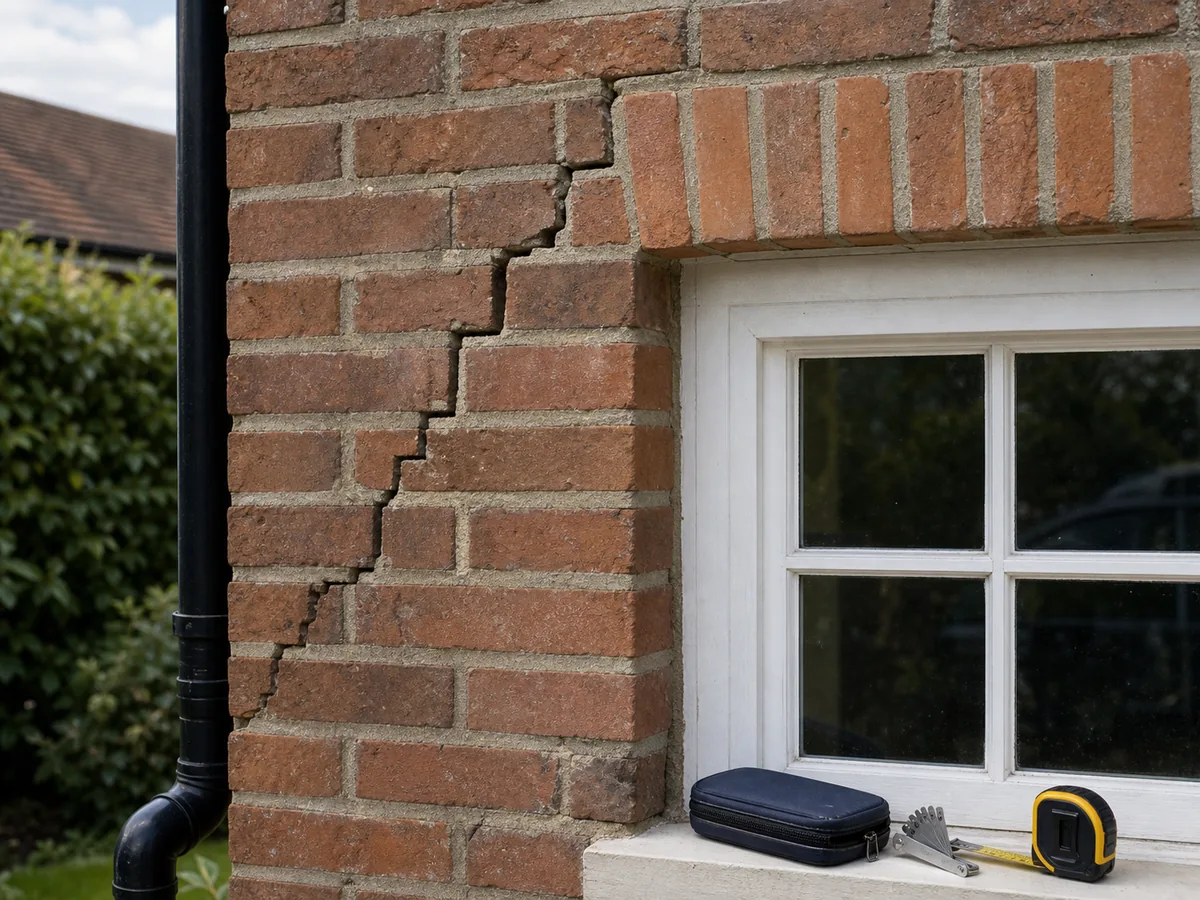
Start with the pattern rather than a single measurement. Record where the crack is, whether it passes through finishes only or continues through masonry, its direction, approximate width and whether a corresponding crack exists on the other side of the wall. Note when it was first seen and whether it appears to be changing. RICS guidance identifies new or expanding cracks in plaster or external brickwork, unexplained sticking doors or windows, ripping wallpaper and new sloping or dipping of solid floors among possible signs of ground movement.
Crack location and pattern matter
Fine cracks at plasterboard joints, around new plaster or where different materials meet can arise from shrinkage or differential thermal movement. Stepped cracking through brick or block joints, diagonal cracking around openings, separation at junctions, distortion of openings or cracks that continue through several building elements can justify closer assessment. None of these features proves subsidence on its own. The age of the building, construction, previous alterations and wider pattern all matter.
Doors and windows can provide useful clues. A door that has always needed adjustment is different from several openings suddenly becoming distorted. Likewise, old uneven floors are common in historic buildings and are not evidence by themselves that movement is active. A change from the property’s established condition is usually more informative than imperfect geometry that may have existed for decades.
Look beyond the crack
Structural movement can show through distortion as well as cracking. Look for walls visibly leaning or bulging, floors developing new falls, roof lines changing, gaps opening between building elements, skirtings separating from floors or extensions pulling away from the original structure. External clues can include damaged drains, leaking water services, significant nearby vegetation, altered ground levels or evidence of previous structural repairs.
Photographs are valuable when they include enough context to relocate the defect later. Take an overall view and a closer image, record the date and avoid repeatedly filling or decorating a crack that is being monitored. RICS notes that some cracks may need monitoring for many months to determine whether movement is continuing.
Width is useful, but not the whole diagnosis
Crack width can help assess significance, but it should not be used as a stand-alone DIY diagnosis. RICS consumer guidance notes that sudden cracks over about 3 mm are a reason for concern, while professional assessment also considers pattern, location, rate of change and associated distortion. A narrow crack that is actively changing may deserve more attention than a wider historic crack that has remained stable for years.
When to treat the situation as urgent
Seek prompt professional advice where cracking appears suddenly or progresses rapidly, where there is obvious distortion, instability, falling material, significant movement around structural openings, or where the building’s safe use is in doubt. Keep people away from visibly unstable areas. If a defect appears immediately after an impact, excavation, structural alteration or other significant event, tell the professional assessing it what happened and when.
2. Common causes: settlement, subsidence, heave and building movement
Structural movement is a broad description. Establishing the cause matters because different mechanisms require different responses. Repairing the crack before understanding why it formed can conceal useful evidence and may result in the crack returning.
Settlement
Settlement is movement associated with a building or its foundations adjusting under load. Some initial settlement can occur after construction. Problems arise where movement is excessive or differential, meaning one part moves differently from another. Extensions built at a different time from the original house can behave differently because foundations, ground conditions and construction vary.
Subsidence
RICS defines subsidence as downward movement of foundations caused by changes in the supporting ground and distinguishes it from settlement. Causes can include shrinkable clay losing moisture, influence from trees and vegetation, and leaking drains or water mains that soften or wash away supporting ground. Ground conditions vary considerably, so a diagnosis should be based on the actual site rather than assumptions about a postcode.
Trees should not automatically be removed because cracking is present. Vegetation, soil type, foundation depth, species, distance and moisture conditions all influence the relationship. RICS specifically cautions that tree removal can sometimes create additional problems, so specialist advice may be appropriate before significant tree work is undertaken as a supposed subsidence remedy.
Heave
Heave is upward ground movement. It can occur where certain soils increase in volume as moisture conditions change. Because the mechanism differs from subsidence, the investigation and remedy can differ too. This is another reason not to label all cracking as “subsidence” from appearance alone.
Drainage and water-related ground movement
Defective drains and water services can affect supporting soils. Where cracking coincides with drainage problems, leakage, washed-out ground or local settlement, drainage investigation may form part of the diagnostic process. RICS notes that repairing leaking pipework can in some cases be sufficient to stabilise the situation without foundation underpinning.
Thermal and moisture movement
Building materials change dimension with temperature and moisture. Long walls, different materials at junctions, render, timber and masonry can all move differently. Where movement joints or detailing are inadequate, cracks can form without foundation failure. Seasonal opening and closing can therefore have a different significance from progressively worsening structural distortion.
Alterations and load changes
Removing walls, forming openings, altering roofs, changing floors or adding loads can change how forces travel through a building. Inadequate support, poorly detailed structural work or historic alterations may cause cracking and distortion. If movement appears around an altered area, structural drawings, Building Regulations records and information about previous work can be useful evidence.
Material deterioration
Corroding embedded steel, decayed timber, failed lintels and deterioration of structural components can create cracking or displacement that resembles ground movement. In coastal and exposed parts of Hampshire and West Sussex, weather exposure can contribute to deterioration of external building fabric, but the cause still needs property-specific assessment.
Historic buildings need context
Older properties may have shallow foundations, flexible timber structures, lime-based materials and a long history of alteration. Some movement and irregularity may be historic and stable. Applying rigid modern repair materials without understanding the construction can create new stresses or simply hide evidence. Where heritage fabric is involved, the assessment should consider both structural behaviour and compatible repair methods.
3. Investigation and monitoring
A structural-movement investigation normally begins with history and visual evidence, then becomes more intrusive only where the findings justify it. RICS guidance notes that foundations usually cannot be inspected during a normal survey without excavation; where evidence suggests structural movement, further investigation may include exposing foundations. This staged approach avoids unnecessary disruption while recognising when visual inspection alone is insufficient.
Build a timeline
Record when the defect was first noticed, whether it followed building work, drought, heavy rainfall, a drainage failure or another event, and whether previous repairs exist. Old photographs, survey reports, planning drawings and Building Regulations records can help establish whether a crack or distortion predates the current concern.
Map and photograph the defects
Record cracks on a simple plan or elevation and photograph them consistently. Note related features such as sticking openings, floor distortion and external drainage. RICS building-pathology guidance emphasises sketches, drawings and photographs as useful ways to record observations.
Monitoring can establish whether movement is active
Where immediate structural danger is not indicated, monitoring may help determine whether cracking is stable, seasonal or progressive. The method should suit the question being asked. Simple dated measurements may be adequate in some cases; more formal crack gauges, level monitoring or specialist instrumentation may be required in others. Do not rely on improvised filler across a crack as the sole evidence of structural behaviour.
Investigate likely causes
Depending on the evidence, further work might include drainage testing or CCTV surveys, trial pits to understand foundations and ground conditions, arboricultural input, structural calculations or specialist assessment of altered building elements. Not every crack requires every investigation. A competent surveyor or structural engineer should direct investigations according to the observed pattern and plausible causes.
Know when a structural engineer is appropriate
A suitably qualified structural engineer should be considered where there is significant or progressive movement, structural distortion, uncertainty about loadbearing elements, proposed structural alterations or evidence that safety may be affected. For complex or high-risk buildings, specialist structural expertise may be essential. The objective is to obtain advice proportionate to the building and defect, rather than commissioning invasive work without a diagnostic basis.
Consider insurers before major remedial work
If subsidence or another insured event may be involved, check the buildings-insurance policy and contact the insurer before committing to substantial investigation or repairs, except where immediate work is required to make the property safe or prevent further damage. RICS notes that insurers often appoint experts to investigate and design repairs. Keep photographs, reports, invoices and correspondence.
DMP Buildtech can assist with initial building-defect investigation, photographic records and remedial works, but where the evidence requires structural engineering or another specialist discipline, that should form part of the investigation rather than being substituted by general building work.
4. Repair and next steps
The correct repair follows the diagnosis. Cosmetic filling may be entirely appropriate for stable, non-structural cracking, but it is not a remedy for active movement. Conversely, major foundation intervention should not be assumed simply because subsidence has been mentioned. RICS states that underpinning is needed in only a minority of subsidence cases and recommends it as a last-resort type of intervention rather than an automatic response.
Resolve the cause before reinstatement
If leaking drainage is contributing to ground movement, repairing the drainage may be central to the solution. If structural support is inadequate, the structural detail must be corrected. If movement is historic and stable, repair may focus on compatible masonry, plaster and decoration. The sequence matters: stabilisation or cause removal first, reinstatement afterwards.
Allow evidence to determine the scale of repair
Repairs can range from local repointing and plaster work to masonry reinforcement, replacement lintels, structural strengthening, drainage repairs or engineered foundation work. The method should be designed for the established defect. Stitching a crack without addressing continuing movement can simply transfer stress elsewhere or fail again.
Check whether approvals are required
Structural repairs and alterations can fall within Building Regulations, and listed buildings or properties in sensitive settings may require additional consent depending on the work. Establish the approval route before irreversible work begins. See our Building Regulations Explained guide for the current England framework.
Use compatible repairs on traditional fabric
Older masonry often requires a different approach from modern cavity-wall construction. Existing lime mortar, soft brick or stone, moisture behaviour and previous repairs should be considered before selecting mortar, render or reinforcement. Our Lime Mortar and Heritage Brickwork Guide covers this in more detail.
Keep a close-out record
Retain the investigation report, monitoring information, engineer’s design where applicable, photographs of opened-up and concealed work, product information and relevant completion documents. If monitoring is required after repair, record the agreed period and method rather than assuming the issue is closed on the day decoration is finished.
When DMP Buildtech can help
For properties across Hampshire and West Sussex, DMP Buildtech’s Remedial Works service can assist with investigation, opening-up, drainage or building repairs and reinstatement once the appropriate scope is established. Our Drone Surveys & Reports can also help record inaccessible external areas where roof or high-level building movement needs visual assessment. Structural engineering is brought in where the nature of the defect requires it.
The most useful response to suspected structural movement is therefore neither panic nor cosmetic concealment. Record what is happening, assess whether it is changing, investigate plausible causes and base repairs on evidence.
Related services
FAQs
Does every crack mean subsidence?
No. Cracking can result from shrinkage, thermal movement, settlement, alterations, material deterioration and other causes. The pattern, history, associated distortion and whether the crack is changing are more informative than the presence of a crack alone.
What signs can indicate possible subsidence?
Possible indicators include new or expanding cracks in internal or external walls, unexplained sticking doors or windows, ripping wallpaper and new dipping or sloping of solid floors. These signs are not proof of subsidence and should be assessed in context.
Should I fill a crack before it is inspected?
If the crack may need investigation or monitoring, record and photograph it before cosmetic repair. Filling it immediately can remove useful evidence. Where there is an immediate safety issue, prioritise making the area safe and seek professional advice.
How long can structural movement monitoring take?
It depends on the defect and suspected cause. Some cracking needs monitoring over many months to establish whether movement is stable, seasonal or progressive. The professional directing the investigation should determine the appropriate method and period.
Does subsidence always mean underpinning?
No. The remedy depends on the cause. Drainage repairs, management of other contributing factors or different structural repairs may be appropriate. Underpinning should be based on proper investigation and engineering advice rather than assumed from the outset.
When should I contact my buildings insurer?
If subsidence or another insured cause may be involved, check the policy and contact the insurer before substantial investigation or repair, except for necessary emergency work to protect safety or prevent further damage. Keep photographs and records of the defect.
Need help with this type of work?
Send DMP Buildtech a short description and photographs. We can advise on the right inspection, quote or maintenance step.
Request a quote or inspection