
Learning Hub Guide
Condensation and Mould Guide
Clear advice on condensation, mould, ventilation, building defects and when further investigation is needed.
Overview
Clear advice on condensation, mould, ventilation, building defects and when further investigation is needed. This guide provides practical background to help property owners and managers understand the subject, recognise key considerations and decide when professional advice or inspection may be appropriate.
What this guide covers
Understand humidity, cold surfaces and why mould often develops in particular locations.
Go to section →Building factorsLook at ventilation, insulation, thermal bridges, heating and moisture production together.
Go to section →Mould responseDeal with visible mould safely while investigating the conditions allowing it to return.
Go to section →Long-term controlCombine building repairs and practical moisture management rather than relying on surface treatments.
Go to section →1. Why condensation and mould form
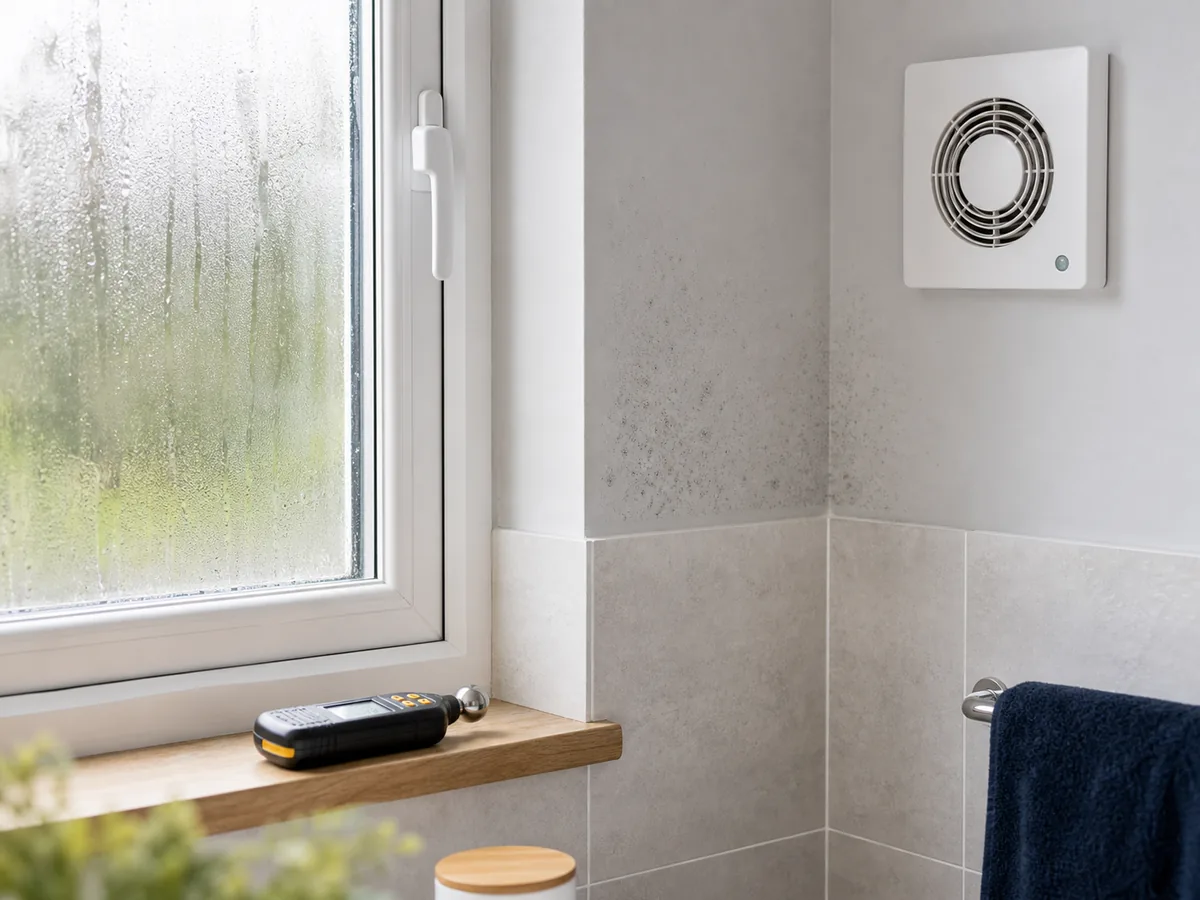
Indoor air contains water vapour from breathing, cooking, bathing, washing and drying clothes. As air cools, its capacity to hold water vapour reduces. When humid air meets a sufficiently cold surface, moisture can condense. Repeated high surface humidity can also support mould growth even where obvious droplets are not visible.
Typical locations include external corners, window reveals, behind wardrobes, around poorly insulated structural elements and rooms with high moisture production. Winter often exposes the problem because external surfaces are colder and windows may remain closed for longer.
Condensation is a building-and-occupancy interaction
It is rarely useful to blame either the building or occupants without investigation. Inadequate extraction, cold bridging, poor insulation, intermittent heating, overcrowding, blocked vents and high moisture production can interact. A good diagnosis looks at all of these factors.
Do not confuse it with water ingress
Rain penetration and plumbing leaks can create damp surfaces that then support mould. If staining corresponds with rainfall, plumbing use or a local defect, investigate those sources. See our Damp Diagnosis Guide and Penetrating Damp Explained.
2. Ventilation, insulation, heating and building defects
Ventilation
Bathrooms and kitchens need effective extraction to remove moisture near its source. Extract fans should discharge outdoors, not into a roof void. Background ventilation and air paths should work as intended. Existing vents should not be blocked simply to stop draughts without understanding their purpose.
For new or altered dwellings in England, ventilation work is governed by Building Regulations requirements and current Approved Document F guidance. Existing properties may need a property-specific solution rather than copying a new-build specification.
Cold surfaces and thermal bridges
Missing insulation, poorly detailed junctions and structural elements can create locally colder surfaces. Mould repeatedly appearing in a consistent geometric pattern can be a clue. Thermal imaging under suitable conditions can help identify temperature differences, but findings need interpretation and may require further investigation.
Heating and temperature
Very cold rooms increase surface-condensation risk. More consistent background heating can help in some properties, but heating alone does not remove moisture. If moisture production remains high and ventilation poor, warm air can simply carry more water vapour to colder surfaces elsewhere.
Furniture and airflow
Large furniture tight against cold external walls can restrict air circulation and create local high humidity. A small air gap may help, but recurring mould should still prompt consideration of insulation, ventilation and other defects rather than being treated solely as a furniture-layout issue.
3. Responding to mould safely and proportionately
Mould should not simply be painted over. Visible growth indicates conditions that have supported fungal growth, so cleaning should be paired with investigation of moisture and temperature conditions. Extensive, recurring or health-sensitive situations may require specialist assessment.
Find and correct the moisture source
Check extraction, ventilation, cold surfaces, leaks and rain penetration. Record where and when mould returns after cleaning. If the affected surface remains persistently wet, surface treatment alone is unlikely to provide durable control.
Cleaning and decoration
For limited surface mould, use a suitable proprietary cleaning method in accordance with product instructions, protect surrounding materials and ventilate appropriately. Avoid dry brushing that spreads spores. Where finishes are badly deteriorated or contamination extends into porous materials, replacement may be appropriate after the moisture problem is controlled.
Landlords and rented homes
Landlords should investigate reports of damp and mould rather than assuming lifestyle is the sole cause. In England, housing providers have legal responsibilities concerning property condition and hazards; the precise duties depend on tenure and circumstances. Records of reports, inspections, findings and remedial action are therefore important.
When to escalate
Seek professional help for extensive or persistent mould, significant water damage, suspected hidden contamination, building defects, or where occupants have particular health vulnerabilities. Building contractors can address fabric defects, while environmental or health concerns may require other competent professionals.
4. Long-term prevention and property improvement
Long-term control usually requires balancing moisture production, ventilation and surface temperature. The correct mix depends on the property. Start by making sure water ingress and plumbing leaks are excluded, then assess ventilation performance, heating patterns and cold building elements.
Maintain extraction
Fans, grilles and ducts need to remain clear and functional. Replacement fans should be appropriately selected and installed. Where ventilation is altered as part of building work, consider Building Regulations requirements and commissioning information.
Improve insulation carefully
Insulation can raise internal surface temperatures and reduce condensation risk, but poorly designed retrofit can create new thermal bridges or moisture traps. Solid-wall and traditional buildings require particular care. Assess the whole construction rather than applying isolated insulation without considering moisture movement.
Monitor after changes
Simple temperature and humidity logging can show whether conditions improve. Photograph recurring areas and note seasonal patterns. For managed property, retain maintenance and tenant communications so repeated defects can be identified rather than repeatedly treated as isolated events.
DMP Buildtech can investigate building defects, ventilation-related building work and associated repairs through our Property Maintenance and Remedial Works services across Hampshire and West Sussex.
Related services
FAQs
What causes condensation on walls?
Condensation risk increases when humid indoor air meets cold surfaces. Moisture production, ventilation, heating, insulation and thermal bridging can all contribute.
Is black mould always caused by condensation?
No. Condensation is common, but leaks and penetrating damp can also create conditions for mould. Recurring mould should be investigated rather than diagnosed from appearance alone.
Will opening windows solve mould?
It may help in some circumstances, but reliable control usually requires appropriate ventilation, moisture management and adequate surface temperatures. Building defects should also be ruled out.
Can insulation reduce condensation?
Correctly designed insulation can raise internal surface temperatures and reduce risk, but poorly detailed retrofit can create thermal bridges or moisture problems. The construction should be assessed as a whole.
Should I just paint over mould?
No. Clean and treat affected surfaces appropriately, but also identify why moisture and cold-surface conditions allowed mould to develop. Decoration without correcting the cause is unlikely to last.
When should persistent mould be professionally investigated?
Arrange assessment where mould is extensive, recurring, associated with water ingress or building defects, or where the underlying moisture source is uncertain.
Need help with this type of work?
Send DMP Buildtech a short description and photographs. We can advise on the right inspection, quote or maintenance step.
Request a quote or inspection