
Learning Hub Guide
Commercial Property Maintenance Checklist
A practical maintenance checklist for commercial property owners, occupiers and managers across Hampshire and West Sussex.
Overview
A practical maintenance checklist for commercial property owners, occupiers and managers across Hampshire and West Sussex. This guide provides practical background to help property owners and managers understand the subject, recognise key considerations and decide when professional advice or inspection may be appropriate.
What this guide covers
Roofs, walls, drainage, openings and external areas that should be checked routinely.
Go to section →Safety & servicesCoordinate statutory duties, fire precautions, asbestos information and specialist servicing.
Go to section →Planned & reactive workPrioritise defects by risk, operational impact and deterioration rather than waiting for failure.
Go to section →Records & contractorsKeep an auditable property record and give contractors the information they need.
Go to section →1. Building fabric and external maintenance
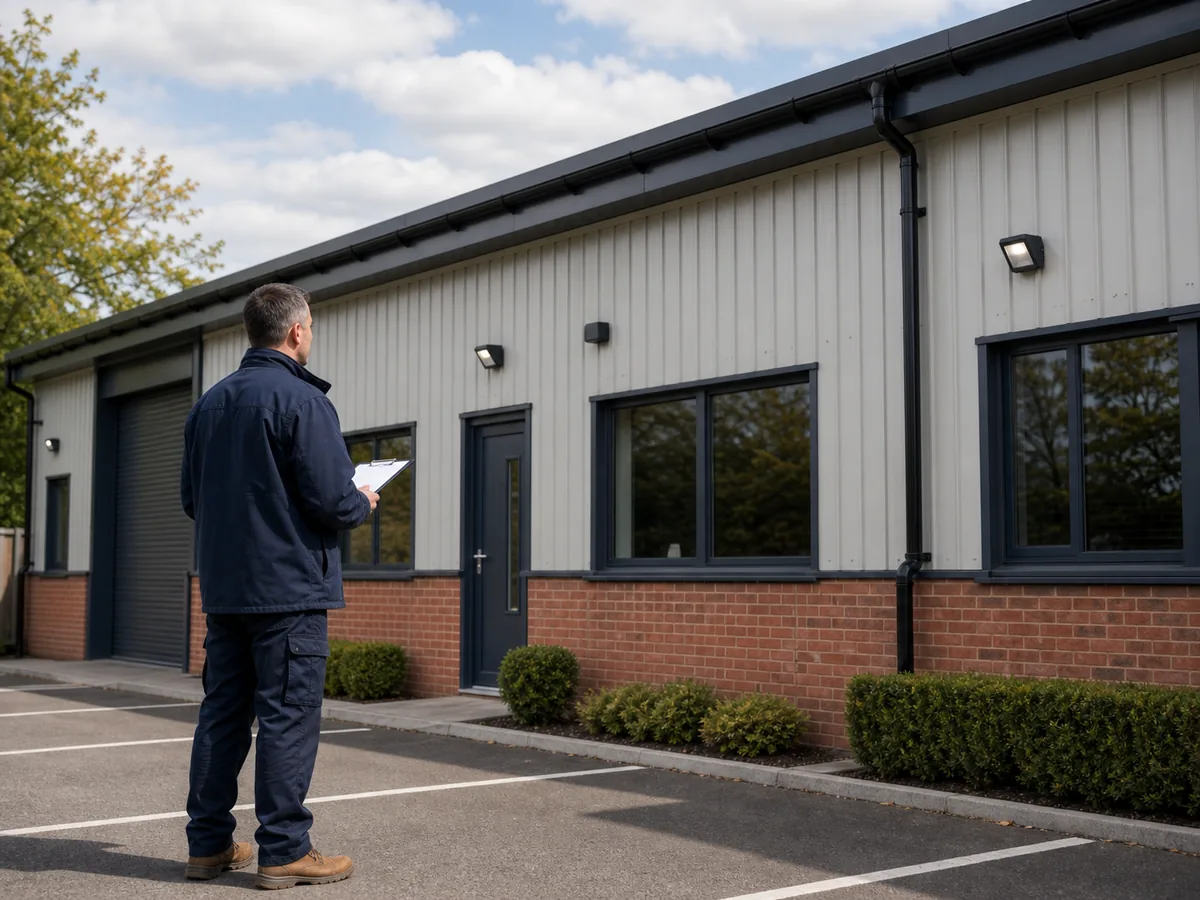
Commercial property maintenance starts with the parts of the building that keep weather out and people safely in. A simple inspection programme should cover roof coverings, flashings, parapets, gutters, downpipes, external walls, pointing, render, windows, doors, seals, drainage, paving, boundary features and accessible external structures.
Frequency should reflect the building rather than an arbitrary calendar. Exposed coastal premises, buildings beneath trees, older roofs and properties with a history of blocked drainage may need closer attention. Inspections after severe weather can identify displaced coverings, overflowing rainwater goods and impact damage before they become major internal repairs.
Roofs and rainwater goods
Look for slipped or damaged coverings, open flashings, blocked outlets, vegetation, staining and signs that gutters overflow. High-level areas should be inspected using safe access methods; a drone survey can be useful where a visual overview is required without unnecessary roof access.
Walls, windows and doors
Check cracking, failed pointing or render, damaged seals, deterioration to frames and signs of water entry. Doors used for security, escape or accessibility may need specialist attention depending on their function. Avoid treating a damp internal finish until the external cause has been investigated.
Drainage and external areas
Keep gullies and channels clear, watch for slow drainage, settlement and trip hazards, and investigate recurring standing water. Surface defects in customer or staff routes should be recorded and prioritised according to risk.
2. Safety, compliance and specialist building services
A maintenance checklist is not a substitute for the statutory assessments and specialist inspection regimes that apply to a particular workplace. Responsibility can also be divided between landlord and occupier by the lease, so the first management task is to establish who controls each part of the premises and each service.
Fire safety
For non-domestic premises in England, the responsible person must ensure an appropriate fire risk assessment is carried out and kept under review, and appropriate fire precautions are maintained. Shared premises can involve more than one responsible person, so coordination matters. Maintenance teams should not alter fire doors, compartmentation, alarm components or escape arrangements without understanding their function.
Asbestos
The duty to manage asbestos can apply to those with responsibility for maintenance or repair of non-domestic premises. Before intrusive maintenance or refurbishment, available asbestos information must be considered and suitable surveys arranged where required. Contractors should receive relevant information before work that could disturb the fabric.
Electrical, gas, lifting and other systems
Use competent specialists for systems requiring statutory or technical inspection and servicing. The exact regime depends on the equipment and workplace. Keep certificates, reports and remedial actions together rather than treating each visit as an isolated event.
Access and work at height
Routine maintenance can create significant risk when roofs, ladders, fragile surfaces or plant areas are involved. Plan access before the job starts and use suitable contractors and equipment. A minor defect does not justify unsafe access.
3. Planned maintenance, reactive repairs and prioritisation
Not every defect has the same urgency. A useful maintenance system separates immediate safety or operational issues from defects that can be planned into a programme. Water ingress near electrics, insecure doors, blocked escape routes and unstable elements demand a different response from cosmetic deterioration.
Create a planned programme
Use condition information to schedule recurring tasks such as roof and gutter inspections, drainage clearance, external decoration, sealant checks and servicing. Grouping work can reduce disruption and repeated access costs. Our Planned vs Reactive Maintenance guide explains the principle in more detail.
Control reactive work
When an urgent defect is reported, record the location, photographs, immediate risk, temporary action and permanent repair required. Temporary repairs should be clearly identified as temporary and followed through to completion.
Protect business continuity
Plan noisy, dusty or access-sensitive work around occupants, customers and operations. Confirm isolation requirements, deliveries, welfare, security and reinstatement before contractors arrive. Larger packages may require formal construction-phase planning and coordination.
4. Records, inspections and contractor coordination
A good commercial maintenance file provides a history of the building. Keep inspection reports, photographs, quotations, work orders, certificates, warranties, asbestos information, fire-safety information, drawings where available and records of completed repairs. This helps future contractors understand what has changed and allows recurring defects to be identified.
Use a defect register
Record each issue with a unique reference, date reported, location, risk or priority, responsible party, action required and close-out evidence. Outstanding actions should be reviewed rather than disappearing into email chains.
Brief contractors properly
Provide access arrangements, known hazards, asbestos information, site rules and relevant drawings before work begins. Confirm whether permits, isolations or out-of-hours arrangements are required. Competence should match the work being undertaken.
Close the loop
At completion, obtain photographs, certificates and product information where relevant. Update the maintenance record and note any follow-up inspection. DMP Buildtech provides Commercial Maintenance and coordinated remedial works for commercial clients across Hampshire and West Sussex.
Related services
FAQs
How often should a commercial property be inspected?
There is no single interval for every element. Frequency should reflect the building, its condition, exposure, use, previous defects and any statutory or specialist inspection requirements.
Who is responsible for maintenance in a leased commercial property?
Responsibility depends on the lease, ownership arrangements and the element concerned. Landlord, tenant, managing agent and occupier duties should be established before work is instructed.
Does a commercial maintenance contractor cover all compliance checks?
Not necessarily. Fire systems, electrical installations, gas, lifts and other specialist equipment may require competent specialist contractors and separate inspection regimes.
What should be recorded after a reactive repair?
Record the defect, risk, temporary action if any, permanent repair, photographs, certificates or product information where relevant, and any follow-up required.
Why is asbestos information important before maintenance?
Work that disturbs building fabric can expose asbestos if relevant materials have not been identified and managed. Applicable asbestos information should be checked and provided to contractors before intrusive work.
When should maintenance become a planned project?
Where work involves multiple trades, significant access, occupied areas, structural or building-envelope repairs, or substantial coordination, planning it as a defined project can improve safety, sequencing and cost control.
Need help with this type of work?
Send DMP Buildtech a short description and photographs. We can advise on the right inspection, quote or maintenance step.
Request a quote or inspection